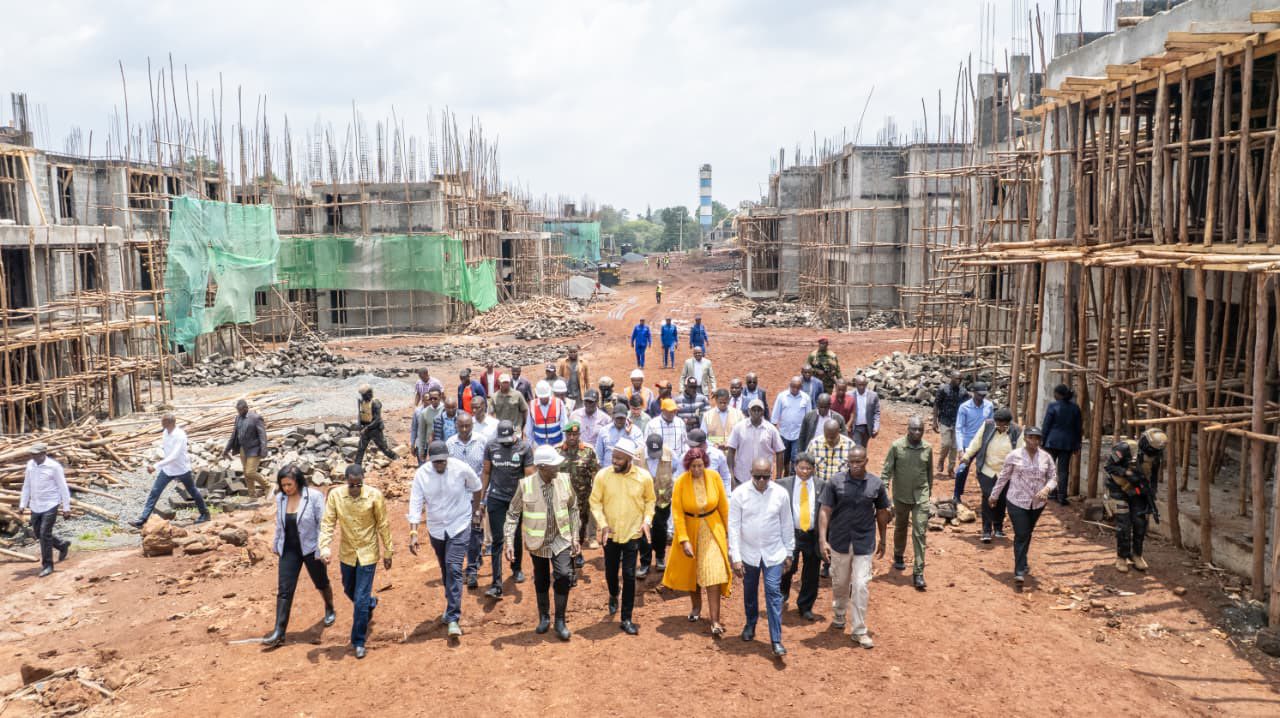
On the edges of Nairobi and in fast-growing satellite towns, rows of unfinished concrete shells are rising from red soil, their steel frames catching the afternoon sun.
To workers on site, they are jobs. To the government, they are homes in waiting. To an increasingly divided political class, they are something else entirely: a campaign story taking shape in real time.
President William Ruto’s Affordable Housing Programme, once introduced as a technical solution to Kenya’s chronic housing shortage, has steadily become one of the most visible features of his public engagements—and, critics say, one of the most politically charged.
What began as a flagship development policy has, over recent months, been woven into nearly every major presidential tour, speech and project launch. Housing now sits alongside roads, electricity and agriculture as a recurring theme in his public messaging, but with a distinct emotional framing: dignity, jobs, transformation and youth opportunity.
The government funds the programme through the housing levy, which deducts 1.5 per cent from workers’ salaries, matched by employers. Officials say the money is financing hundreds of thousands of housing units across the country while generating employment in construction and related industries.
But the levy has also become one of the most contested policies of the Kenya Kwanza administration. Workers argue that it reduces already-strained take-home pay, while critics say it does not guarantee ownership or direct benefit to contributors.
Even within official explanations, it has been clarified that the deductions are not individual savings accounts and do not automatically translate into allocation of a house. That distinction, repeated in policy briefings, has done little to ease public anxiety.
Still, President Ruto has remained firm in his defence. In speech after speech, he has framed the housing programme as a long-term national transformation strategy that cannot be paused without economic consequences.
“The housing programme is not just about shelter; it is about transforming livelihoods and creating employment for our young people,” he has said, often tying it to broader promises of economic revival.
But as the programme expands across counties, a different interpretation has begun to take hold in Kenya’s political discourse.
Former Deputy President Rigathi Gachagua has emerged as one of its most vocal critics, questioning both its urgency and its design. In public remarks, he has argued that the government is misreading the country’s economic reality, where the immediate struggle is not housing but survival.
“The people are struggling with basic needs. Before talking about houses, we must first address the cost of living and put food on the table,” Gachagua has said, warning that compulsory deductions risk deepening household distress.
He has also criticised the structure of the levy itself, arguing that workers are being forced into a system that offers no guaranteed return or ownership, turning what is presented as development into financial pressure on the poor.
Other opposition figures, including Wiper Party leader Kalonzo Musyoka, have raised similar concerns. While acknowledging Kenya’s housing deficit, they argue that the financing model places a disproportionate strain on salaried workers amid high inflation and stagnant wages.
Some opposition leaders have gone further, pledging to review or scrap the levy entirely if they assume power, arguing that alternative funding models could deliver housing without compulsory payroll deductions.
“This is not a priority that should be financed by squeezing workers further,” one opposition leader said recently, capturing a sentiment that has gained traction in public debate.
Within government circles, however, the programme is defended as one of the clearest demonstrations of economic delivery under Ruto’s administration. Allies point to construction sites spread across major urban centres, arguing that the visible rise of housing blocks reflects a policy already in motion rather than a promise deferred.
They also highlight the broader economic ripple effect: demand for cement, steel, transport services and informal labour, all tied to construction activity linked to the programme.
“The numbers being generated in terms of jobs and economic activity cannot be ignored,” one senior government official said, insisting that the programme is still in its early phases but already producing measurable impact.
Yet even as officials point to economic gains, questions persist over who will ultimately benefit. For many Kenyans contributing monthly to the levy, uncertainty remains over affordability and access once the units are completed. Critics warn that without clear allocation and pricing frameworks, the programme risks producing houses that remain out of reach for the very workers financing them.
Those concerns have deepened a sense of ambiguity around the programme’s social promise. Is it a path to ownership for contributors, or a broader urban development strategy whose benefits will be indirect and uneven?
That ambiguity has helped turn the housing programme into a politically charged symbol.
In government messaging, it represents delivery, scale and transformation. In opposition rhetoric, it has become shorthand for economic strain and contested priorities. In public conversation, it sits uneasily between hope and hesitation.
Analysts say this duality is what gives the programme its political weight.
“The housing programme is no longer just policy. It is becoming political language,” one analyst, James Otieno observed. “It is being used to signal performance, but also to trigger debate about cost, fairness and priorities.”
As Kenya moves gradually toward the 2027 election cycle, that language is becoming more frequent and more pointed. Every new housing launch doubles as both a development update and a political statement. Every critique becomes part of a wider argument about economic direction.
On the ground, however, the reality remains more immediate and less abstract: workers waiting for wages, deductions appearing on payslips, and half-built structures slowly rising into skylines across the country.
For now, the cranes continue to move. But so too does the political meaning attached to them—shifting the housing programme from a policy about shelter into one of the most closely watched narratives in Kenya’s emerging political contest.