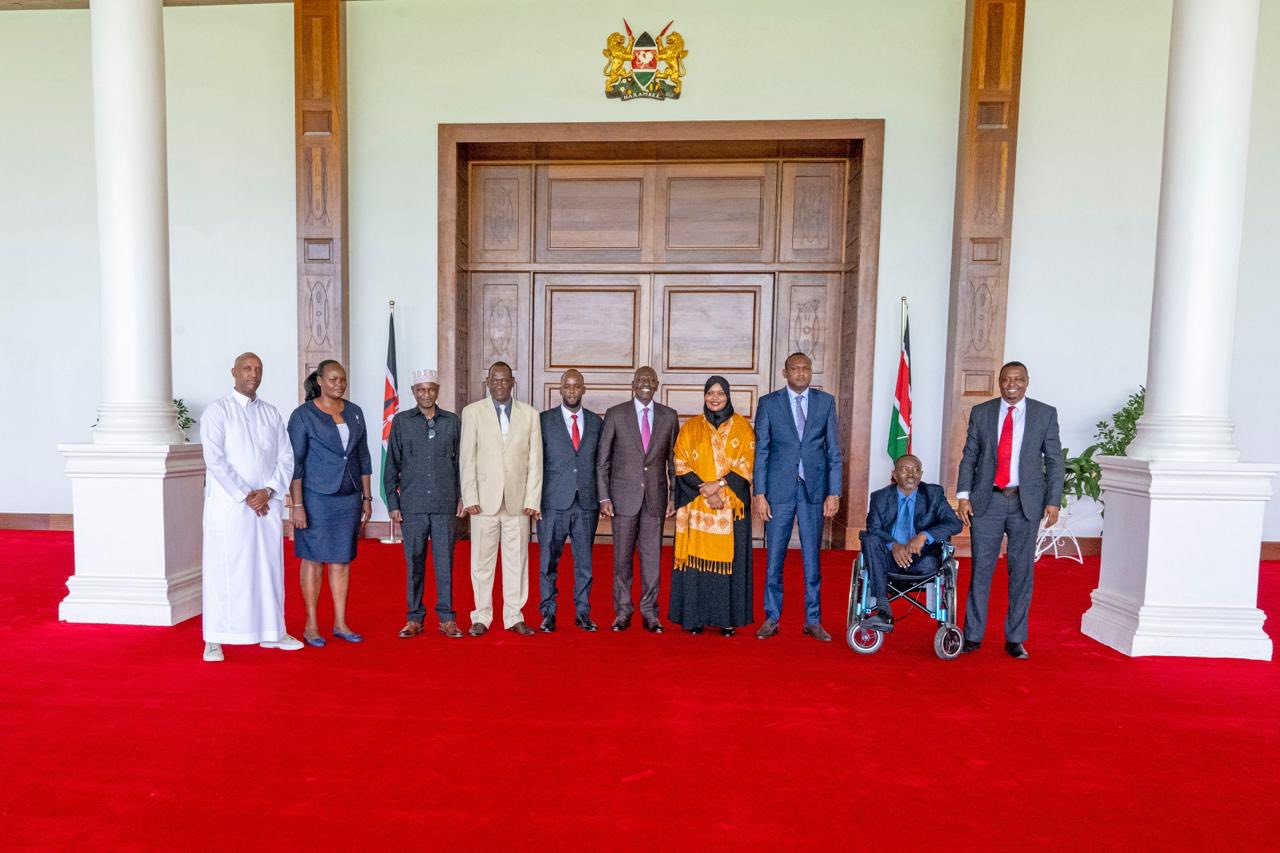
Inside the heavily guarded gates of State House, Nairobi, a steady procession of county delegations has become a defining feature of President William Ruto’s political calendar — one that is now increasingly being read through the lens of the 2027 election.
Governors, Members of Parliament, Members of County Assemblies, grassroots organisers, women leaders, youth representatives and local political brokers arrive in organised groups from across Kenya, drawn from counties including Kitui, Nairobi, Murang’a and other regions, in what are officially described as development consultations between the national government and devolved units.
“We deliberated on priority development projects and how to accelerate service delivery to our people,” Ruto said after meeting leaders from Kitui County, where discussions centred on infrastructure, water access and electricity expansion.
But while the Presidency frames the meetings as routine governance engagements meant to align national and county priorities, their scale, frequency and composition have increasingly drawn political interpretation — with critics arguing that State House has effectively become a strategic hub for early political mobilisation ahead of the 2027 polls.
Opposition figures and governance analysts say the structure of the meetings — which often bring together large, coordinated delegations — raises questions about logistics and costs, including transport arrangements, accommodation and security coordination, all of which they argue ultimately draw on public resources.
Some critics further contend that the inclusion of MCAs, ward-level operatives and grassroots mobilisers transforms the meetings from policy coordination forums into political networking sessions that mirror election-ground organisation.
“This is not just governance engagement; it is political organisation being conducted from the highest office,” a Nairobi-based political commentator said. “When you bring together ward leaders, MCAs and grassroots coordinators from multiple counties, you are essentially mapping and strengthening political structures.”
The Presidency has not directly engaged the cost-related criticism in detail, but government allies maintain that the engagements are fully within the constitutional mandate of the executive to coordinate development across Kenya’s devolved system.
They argue that bringing county leaders directly to State House improves efficiency in tracking development projects and eliminates bureaucratic delays that often slow down implementation at both national and county levels.
In recent weeks, State House has hosted delegations from different regions in quick succession — including Nairobi MCAs, Murang’a grassroots leaders and political representatives from parts of Eastern Kenya — in meetings that typically combine presentations of local priorities with assurances on follow-up action from national agencies.
However, it is the composition of these delegations that has intensified scrutiny. Unlike traditional high-level State House engagements dominated by governors and senior officials, the current format draws in a wider political base that extends deep into ward-level structures.
That shift, analysts say, has effectively placed State House at the centre of a growing national network of local political actors — a system that some interpret as strengthening governance coordination, while others see it as consolidating political influence ahead of 2027.
For supporters of the President, the approach reflects a deliberate strategy to shorten the distance between national decision-making and grassroots implementation, ensuring that development commitments are directly communicated to those who influence local outcomes.
For critics, however, the concern is increasingly political as well as financial. They argue that repeated large-scale meetings at State House risk blurring the line between official government business and political mobilisation, especially at a time when economic pressures have heightened public sensitivity to government spending.
The debate is unfolding against a backdrop of rising cost-of-living concerns and broader scrutiny of public expenditure across government institutions, with opposition voices increasingly framing the State House engagements as part of a longer-term political positioning strategy ahead of the next general election.
Government allies reject that interpretation, insisting that no campaign activity is being conducted and that the meetings remain strictly focused on development delivery and intergovernmental coordination.