
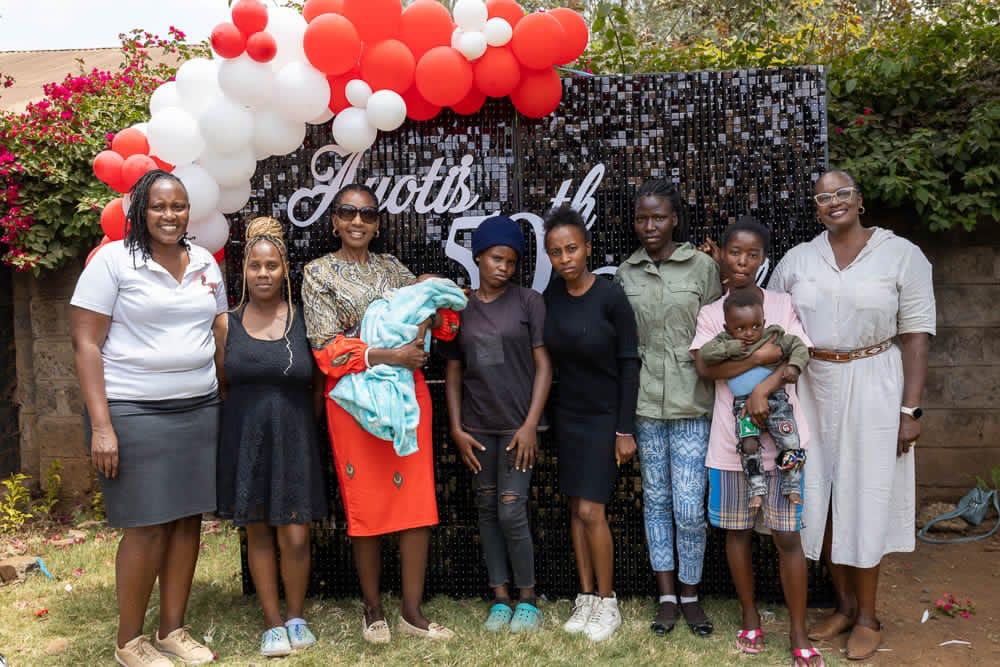
Kenya marked an unusual Valentine’s Day this year not with roses and candlelight dinners, but with a powerful gesture of compassion and inclusion.
In Nairobi, Birth and Beyond Kenya brought together 100 teenage mothers for a first-of-its-kind celebration aimed at restoring dignity, challenging stigma and drawing national attention to a group often overlooked in policy and public discourse.
The initiative comes against a sobering backdrop.
According to the Kenya Demographic and Health Survey, nearly one in five girls aged 15–19 in Kenya is either pregnant or already a mother.
Globally, pregnancy and childbirth complications remain the leading cause of death among adolescent girls in this age group.
Yet teenage mothers particularly those from low-income communities rarely feature in conversations about education, economic empowerment or healthcare access.
Organisers said the event was designed to change that narrative.
“These young women are not statistics. They are daughters, students and future leaders who deserve support, not shame,” said Ayoti Bukachi-Thande, Director of People & Culture at the Financing Alliance for Health, who initiated the gathering.
“Love means showing up, especially for those society has pushed aside. Through the generosity of our partners, each young mother went home with food, clothing and essential items for her family. This is what community looks like.”
Corporate partners including Unga, Isuzu East Africa, Coca-Cola, Flora Group and Jade Collections provided food packages, clothing and household essentials, turning the day into both a celebration and a practical support intervention.
Beyond the emotional impact, stakeholders emphasised the wider national significance of the issue.
When teenage mothers drop out of school, Kenya loses potential teachers, entrepreneurs, healthcare workers and innovators.
The consequences ripple through workforce productivity, public health systems and long-term economic growth.
Experts note that adolescent mothers often face interrupted education, limited employment prospects, social isolation and intergenerational poverty. Some are as young as 14, and in extreme cases pregnancies have been reported among even younger children, with many incidents still going unreported in marginalised regions.
Birth and Beyond Kenya, founded in 2019 by former teenage mother Patricia Njeri, has already supported more than 2,000 girls through mentorship, counselling, vocational training and dignity-kit distribution.
In November 2025, the organisation launched the Marua Hub a digital learning centre developed with Branch International that provides computers and skills training at minimal or no cost.
“We must stop asking only how to prevent teenage pregnancy and start asking how we restore those already living it,” Njeri said. “When we create safe spaces, we replace isolation with opportunity. Prevention matters, but so does restoration.”
For many of the young mothers in attendance, the event was their first experience of being publicly celebrated rather than judged a symbolic shift that organisers hope will inspire broader social change.
The Valentine’s Day gathering was therefore more than a one-day celebration.
It served as a call to action for communities, institutions and policymakers to invest not only in prevention, but also in rehabilitation and reintegration strengthening families, supporting adolescent girls and helping break cycles of vulnerability that follow teenage pregnancy.