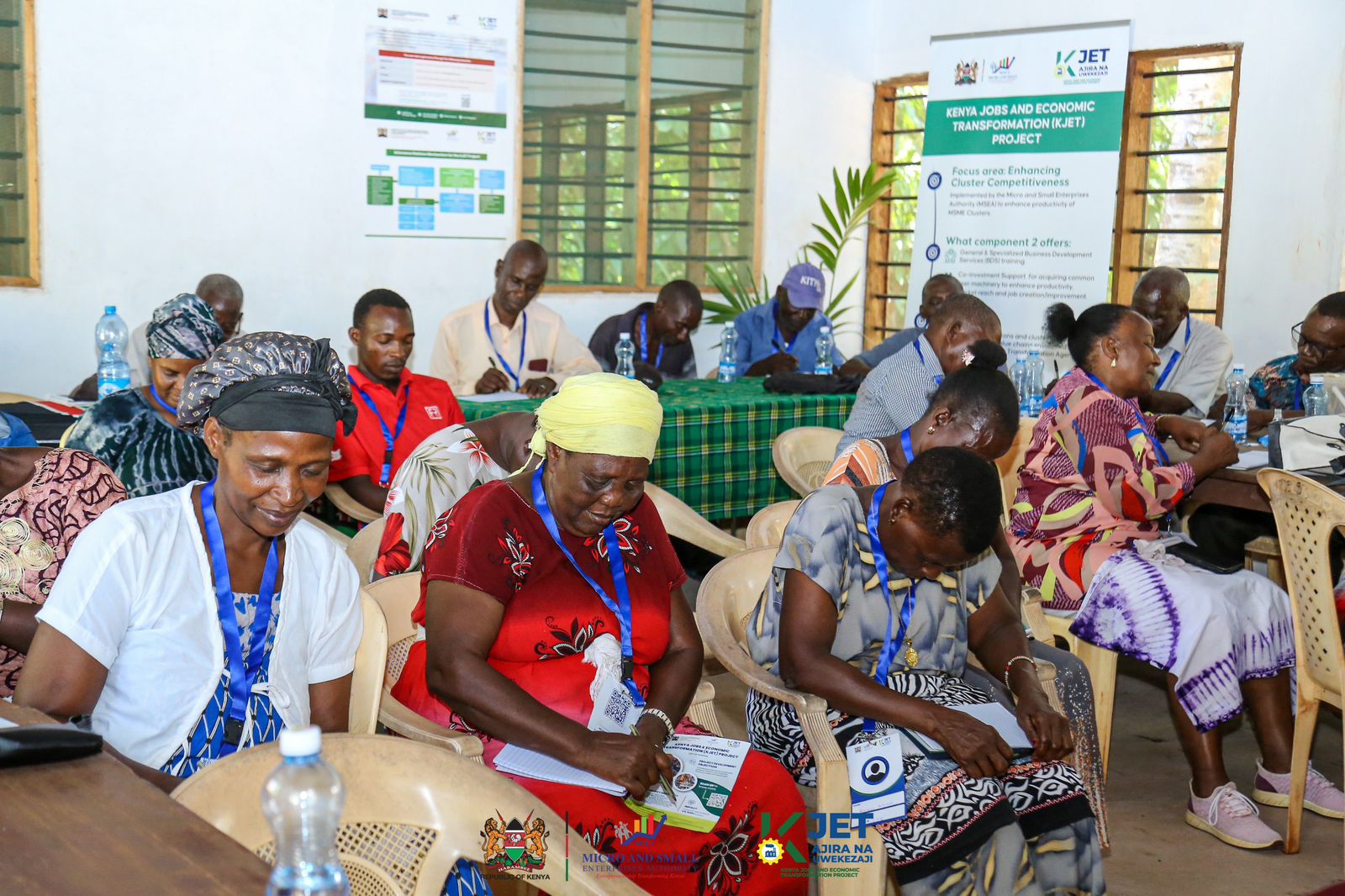
The Micro and Small Enterprises Authority (MSEA) has launched the Cohort 1 Business Development Services (BDS) Classroom Training under Component 2 of the Kenya Jobs and Economic Transformation (KJET) Project, aimed at strengthening competitiveness among MSME clusters.
The training, which officially began on 10 November 2025 across ten counties, will progressively be implemented in all 47 counties over the next five weeks, ultimately reaching the 94 clusters selected under Cohort 1.
Component 2 of the KJET Project seeks to enhance the productivity and growth of Micro, Small, and Medium Enterprise clusters operating within the 10 priority value chains identified under the Bottom-up Economic Transformation Agenda (BETA): edible oils, construction materials, textiles, rice, tea, coffee, dairy, leather, blue economy, and minerals.
Through structured BDS training and targeted co-investment support, the project aims to stimulate enterprise development, improve market access, and support the creation and improvement of jobs.
The nationwide exercise equips selected MSME clusters with practical business skills drawn from a robust 12-module curriculum, designed to enhance enterprise performance, increase productivity, and build long-term competitiveness. The sessions include hands-on exercises, case studies, and interactive group work facilitated by experienced trainers.
Speaking during the commencement of the training in Isiolo County, MSEA Director General Mr. Henry Rithaa emphasized that the initiative seeks to transform MSMEs into engines of innovation and inclusive economic growth.
> “This training marks a pivotal shift in how MSMEs are supported in Kenya. For the first time, clusters across all counties are receiving structured, practical, and market-driven skills that directly address the gaps limiting their growth. Our goal is simple — to enhance productivity, unlock new markets, and position Kenyan enterprises to compete regionally and globally. The KJET Project is not just a training intervention; it is an investment in the long-term competitiveness and resilience of our MSMEs under the BETA agenda,” said Mr. Rithaa.
Upon completion of the classroom phase, clusters will proceed to a three-month mentorship programme, where each group will receive tailored, in-person support to apply their training, refine operations, and strengthen overall business performance.
MSEA is encouraging eligible cooperatives, associations, and cluster-based MSMEs to apply for Cohort 2 of the BDS Training, now open until 31 December 2025. Interested groups are advised to apply early through the KJET portal: kjet.msea.go.ke.