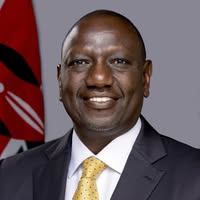
Kenya’s President William Ruto has waded into Tanzania’s disputed election, saying that a 96 percent victory margin is “unrealistic in any democracy,” a comment that has reignited debate over electoral integrity and leadership accountability in East Africa.
Speaking during an interview with Al Jazeera on the sidelines of the World Summit for Social Development in Doha, Ruto was pressed to comment on President Samia Suluhu Hassan’s re-election, which Tanzania’s electoral commission declared at an overwhelming 97.66 percent of the vote.
“It’s not for me to judge Tanzania,” Ruto said. “In a democracy, for example in Kenya, you can never get 96 percent. Every country has a way of doing its stuff. But I think democracy is the best governance system.”
He added, “We should stick to democracy, and we must always give ourselves the opportunity to listen to alternative views without injecting violence into the equation.”
The remarks, light in tone but heavy in implication, came just days after opposition leaders in Tanzania rejected the election results, alleging widespread irregularities, intimidation, and exclusion of key candidates. The main opposition party, CHADEMA, accused the government of using state institutions to stifle dissent and silence independent monitors.
A sensitive neighborly subject
Ruto’s comments, while carefully worded, touched a nerve in a region where leaders have long been accused of manipulating elections to cling to power. By referencing Kenya’s own tightly contested 2022 race — in which he won with 50.5 percent — Ruto appeared to draw a contrast between competitive politics and manufactured consensus.
Diplomats and political analysts say the statement was an attempt to position Kenya as a champion of democratic pluralism, without directly offending Dar es Salaam. “Ruto was signaling to the region that credible elections are defined by genuine contestation,” said Nairobi-based political scientist Kamau Otieno. “He knows Kenya’s democracy is far from perfect, but he’s reminding others that near-unanimous wins are almost always suspect.”
The Tanzanian government has not officially responded to Ruto’s remarks, though state media have downplayed external commentary, insisting that the polls were “peaceful and legitimate.”
A history of troubled elections
Tanzania’s ruling party, Chama Cha Mapinduzi (CCM), has been in power since independence in 1961, and no opposition candidate has ever come close to unseating it. President Samia’s landslide follows a pattern seen in her predecessor John Magufuli’s 2020 win, when he claimed more than 84 percent of the vote amid similar allegations of fraud.
This year’s polls were marred by arrests of opposition figures, restrictions on rallies, and what human rights groups described as a “climate of fear.” The African Union observer mission said the vote “did not comply with democratic standards,” citing irregularities in tallying and limited transparency. At least 20 people were reportedly killed in post-election protests, according to local human rights organizations.
Ruto’s balancing act
For Ruto, the episode presents both an opportunity and a diplomatic tightrope. Kenya and Tanzania share deep trade ties and cooperate on regional security, but Nairobi has also sought to assert itself as a defender of democratic governance on the continent.
“Ruto was making a broader point about legitimacy and inclusion,” said regional affairs analyst Angela Mabinda. “He was careful not to attack Tanzania directly, but his audience — both domestic and foreign — heard the message.”
Kenya, often praised for its lively political scene and independent press, has nonetheless faced its own challenges. Ruto’s election was contested by opposition leader Raila Odinga, and his government continues to battle perceptions of shrinking civic space.
Still, Ruto’s insistence that “you can never get 96 percent in a democracy” may resonate with reformists across the region. The remark underscores a growing divide in East Africa — between governments seeking to entrench control and those grappling, however imperfectly, with the unpredictability of free choice.
Regional reverberations
Observers say Ruto’s comment reflects a broader unease about the direction of democracy in Africa. From Uganda’s long-serving President Yoweri Museveni to Rwanda’s Paul Kagame, whose elections routinely exceed 90 percent, overwhelming victories have often raised suspicions of electoral manipulation rather than enthusiasm.
“Tanzania’s numbers are part of a pattern we’ve seen across the continent — high turnouts, high margins, but low trust,” said political analyst James Wako. “Ruto’s statement is less about Tanzania than it is about what kind of Africa he wants to lead.”