By Njeri Irungu.
The Institution of Surveyors of Kenya (ISK) has thrown its weight behind government efforts to reclaim and protect riparian reserves, even as it called for legal clarity and strict adherence to due process in ongoing demolitions.
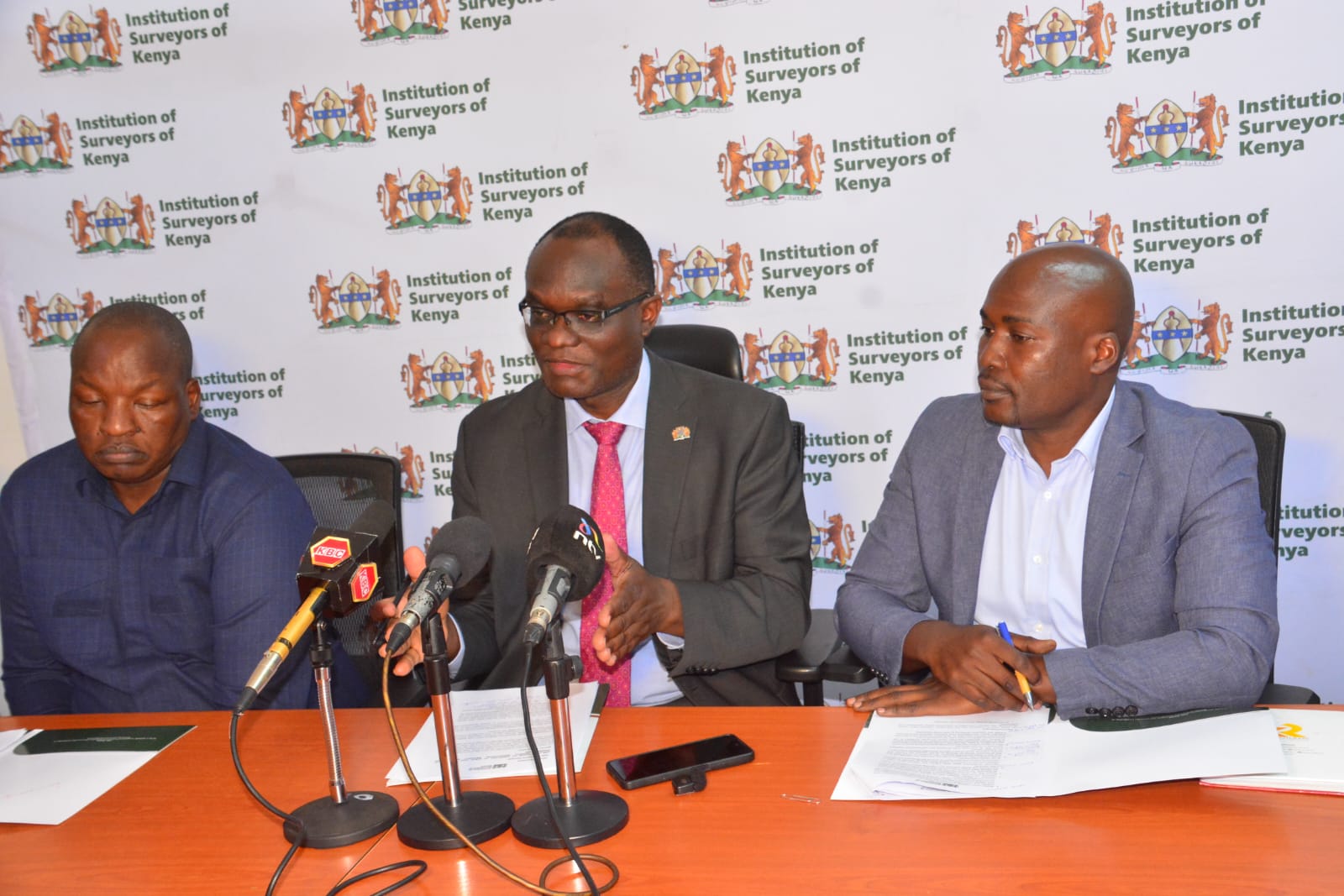
Speaking in a press statement issued Tuesday in Nairobi, ISK President Eric Nyadimo said the initiatives under the Nairobi Rivers Regeneration Project are necessary to safeguard the environment and address persistent flooding.
“We unequivocally support the Government’s efforts to protect water bodies, restore riparian ecosystems, mitigate flooding, and promote sustainable environmental management,” Nyadimo said, describing the interventions as both timely and necessary.
However, Nyadimo raised concern over inconsistencies in how riparian reserves are defined and enforced, warning that the lack of harmonised standards has fuelled disputes and uncertainty.
“Effective management of riparian reserves is hampered by multiple laws, inconsistent measurements, and varying points of reference,” he said, noting that the confusion has contributed to encroachment and conflicting claims.
The statement comes amid recent demolitions of structures along waterways, which have drawn mixed reactions from the public and professionals. Nyadimo attributed the tensions to unclear definitions of reserve boundaries, including differing interpretations of setback distances and reference points such as riverbanks and high-water marks.
He cautioned against the assumption that riparian reserves automatically constitute public land, arguing that ownership and usage rights must be carefully distinguished.
“Riparian reserves should be treated like other reserves. The issue is about use and access subject to development control, not necessarily ownership,” Nyadimo said.
The ISK president stressed that property rights must be respected, particularly where land was lawfully acquired and developed under previous legal frameworks.
“Where a landowner was issued with a valid title based on an approved survey plan, and development approvals were lawfully granted, subsequent policy changes cannot be applied retroactively to deprive the proprietor of land without due process,” he said.
Nyadimo added that in such cases, any state action resulting in loss of land amounts to compulsory acquisition and must follow constitutional provisions, including valuation, notice, gazettement, and prompt compensation.
At the same time, he drew a distinction between legally acquired properties and those obtained fraudulently or developed in violation of existing laws.
“Properties that were illegally allocated or developed in blatant disregard of approvals do not attract constitutional protection, and enforcement actions may proceed, subject to due process,” he noted.
Nyadimo further called for urgent harmonisation of laws and technical standards governing riparian reserves, as well as greater public participation in enforcement processes.
“Enforcement must strictly comply with legal requirements, including adequate notice, stakeholder engagement, and respect for administrative fairness. Demolition should only be a measure of last resort,” he said.
Beyond legal concerns, he highlighted broader causes of flooding, including poor drainage systems, overdevelopment, vegetation clearance, and waste dumping in waterways.
“Simple interventions such as unclogging drainage systems, enforcing zoning regulations, and proper urban planning can go a long way in addressing flooding,” Nyadimo added.
He reaffirmed ISK’s commitment to working with government agencies and stakeholders to ensure that riparian management is both environmentally sustainable and legally sound.
“Sustainable environmental management must not come at the expense of constitutional guarantees, professional integrity, or public confidence in land administration,” he said.