By Njeri Irungu
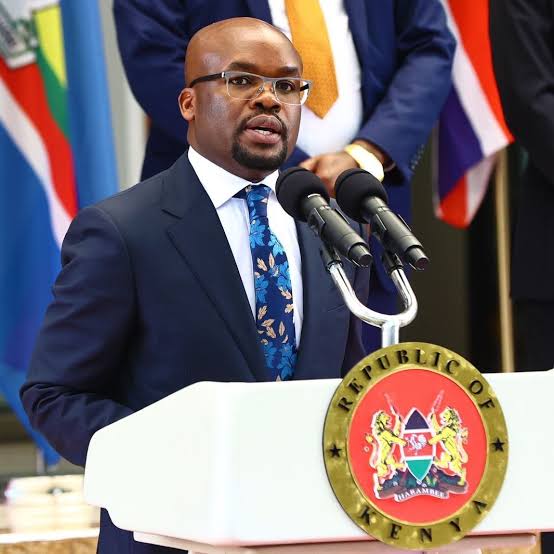
The government has achieved 55 per cent implementation of sweeping reforms across Kenya’s security services, the Principal Secretary in the State Department for Internal Security and National Administration, Dr. Raymond Omollo, has announced, signalling steady progress in efforts to modernise and strengthen the sector.
Speaking during a briefing attended by senior officials from across the security apparatus, Dr. Omollo said the reforms span the National Police Service, Kenya Prisons Service and the National Youth Service, and are being coordinated through a multi-agency National Steering Committee. The committee brings together leadership from the three services, oversight bodies and key institutions including the Public Service Commission and the Salaries and Remuneration Commission.
The PS noted that the reforms, which stem from a task force report sanctioned by the President, comprise more than 500 recommendations, with the largest share affecting the National Police Service. A significant portion also targets the Kenya Prisons Service, while about 100 recommendations relate to the National Youth Service.
“Notable progress has been made, particularly in administrative reforms that did not require additional resources or legislative changes,” Dr. Omollo said, adding that these measures have already been fully implemented.
Among the key milestones is the phased review of officers’ salaries. The second phase of remuneration adjustments has been implemented, with the final phase set to take effect at the start of the 2026/2027 financial year on July 1. Once complete, the review will deliver up to a 40 per cent increase in pay, a move the government says has significantly boosted morale, especially among junior officers.
The government has also intensified recruitment to address longstanding personnel shortages caused by retirements and attrition. At least 10,000 police constables are currently undergoing training, while more than 3,800 prison officers recently graduated in a ceremony presided over by the President.
Efforts to harmonise human resource structures across the services are also underway, with support from the Public Service Commission and the Salaries and Remuneration Commission. The alignment aims to create uniformity in job grading and improve fairness in career progression.
On infrastructure, Dr. Omollo highlighted ongoing investments in modern equipment, particularly within the police service, though he acknowledged more work remains. Housing remains a major challenge, with a deficit of more than 50 per cent across the three services. To address this, over 5,000 housing units are currently under construction nationwide, with the National Police Service identified as the most affected.
Legislative reforms are also progressing, with several bills at the public participation stage or awaiting tabling in Parliament. These proposed laws seek to strengthen areas such as forensic evidence handling, public engagement, inter-agency coordination in crime management and oversight mechanisms.
Despite the gains, Dr. Omollo acknowledged that nearly 40 per cent of the reforms are yet to be implemented, but expressed confidence that the remaining work will be completed within the next year.
“This is about ensuring our officers are well-equipped and supported to serve the public effectively,” he said. “Ultimately, these reforms are meant to enhance public safety and improve service delivery for all Kenyans.”
The update comes as the government continues to prioritise security sector transformation as a key pillar in maintaining law and order while responding to evolving security challenges.