By Njeri Irungu,
26 February 2026,
Nairobi, Kenya.
A renewed call to translate regional reform into tangible economic gains defined the close of the East African Business and Investment Summit & Expo 2026 (EABIS 2026), as leaders from government and the private sector adopted an ambitious set of resolutions aimed at deepening integration and accelerating trade and investment across the region.
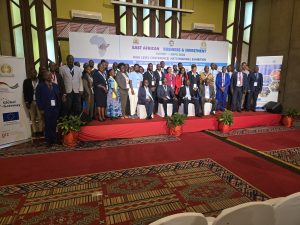
The two-day Summit, convened in Nairobi by the East African Business Council (EABC) in partnership with the Kenya Private Sector Alliance (KEPSA) and the East African Community (EAC) Secretariat, brought together more than 450 delegates. Ministers, senior government officials, industry leaders, development partners, and investors gathered under the theme “Promoting Private Sector-Driven Regional Integration for Increased Intra- and Extra-EAC Trade and Investment,” united by a shared conviction that East Africa must move decisively from policy reform to measurable results.
Opening the Summit, Hon. Beatrice Askul Moe, Chairperson of the EAC Council of Ministers and Kenya’s Cabinet Secretary for EAC, ASALs and Regional Development, described the forum as a testament to the region’s collective ambition to build an economically vibrant and globally competitive Community. While acknowledging that intra-regional trade and cross-border investments have grown steadily over the past two decades, she challenged stakeholders to accelerate implementation of agreed frameworks to unlock the full promise of integration.
That urgency was echoed by EABC Chairperson John Lual Akol Akol, who noted that intra-EAC trade remains below 15 percent of total trade—well short of the bloc’s 40 percent target by 2030. The region, he said, stands at a pivotal moment in its economic transformation, requiring coordinated action from governments and the private sector to eliminate long-standing bottlenecks that constrain competitiveness.
Throughout the Summit’s high-level dialogues and technical sessions, delegates repeatedly pointed to non-tariff barriers, regulatory inconsistencies, and unpredictable tax regimes as key obstacles to business growth. KEPSA Chairperson Dr. Jas Bedi emphasized that harmonizing domestic taxes, operationalizing the Single Customs Territory, and investing in digital customs systems and trade-enabling infrastructure would significantly reduce the cost of doing business and strengthen investor confidence.
By the Summit’s conclusion, leaders had endorsed a wide-ranging reform agenda anchored on practical implementation. Partner States committed to fully operationalizing Customs Union and Common Market protocols, including harmonized tax frameworks and the elimination of non-tariff barriers. There were strong calls for 24-hour border operations, interoperable cargo tracking systems, and continued investments in rail, pipelines, industrial parks, and cold-chain infrastructure to lower logistics costs and improve efficiency along key corridors.
Services trade and air transport liberalization also featured prominently in the resolutions. Delegates urged EAC Partner States to expedite harmonization of regulatory frameworks governing professional services and to set clear timelines toward a fully integrated regional services sector, in line with the Monetary Union roadmap. On aviation, the Summit called for swift adoption of the Single African Air Transport Market and the finalization of regional air services regulations to reduce travel costs and enhance connectivity.
Industrialization emerged as a central pillar of the reform blueprint. Partner States were encouraged to uniformly apply the Common External Tariff, treat EAC-originating manufactured goods as transfers rather than imports, and strengthen public-private partnerships to mobilize capital for priority value chains such as pharmaceuticals, motor vehicles, textiles, leather, and agro-processing. Addressing structural constraints—particularly high energy costs and inadequate transport networks—was identified as critical to safeguarding last-mile industrial investments.
The Summit further underscored the importance of digital transformation in driving competitiveness. Delegates backed the expansion of interoperable digital trade facilitation systems, harmonized e-commerce regulations, unified courier standards, and cross-border digital payment systems to support seamless online trade. A unified regional track-and-trace system for digital tax stamps was also proposed to enhance transparency while minimizing compliance costs for manufacturers.
Small and medium-sized enterprises were placed at the heart of the regional growth strategy. Governments and financial institutions were urged to move beyond collateral-based lending toward data-driven credit models leveraging mobile money and cash-flow records. Expanded credit guarantee schemes, blended finance instruments, financial literacy programs, and simplified cross-border trade procedures under the Simplified Trade Regime were identified as essential tools to unlock SME growth, particularly for women- and youth-led enterprises.
Green logistics and sustainable mobility also gained prominence, with stakeholders calling for bankable projects, regulatory clarity, and financial incentives to attract private capital into electric mobility, renewable energy charging infrastructure, and local assembly of green transport technologies. Enhanced coordination between corridor authorities, governments, and private operators was seen as key to scaling environmentally sustainable transport solutions.
The Summit expressed appreciation to development partners—including the German Development Cooperation, TradeMark Africa, the European Union, the International Trade Centre, the African Development Bank, the East African Development Bank, Isuzu East Africa, RSM Eastern Africa, and the African Civil Aviation Commission—for their support in delivering the event.
In closing remarks, EABC Vice Chairperson Dennis Karera thanked the Government of Kenya for hosting the Summit and urged stakeholders to prioritize implementation of the adopted resolutions. The document, formally signed by Hon. Askul Moe and EABC Chairperson John Lual Akol Akol, now stands as a collective commitment to translate dialogue into action.
As delegates departed Nairobi, the message was clear: East Africa has laid out an ambitious roadmap. The true test now lies not in policy articulation, but in the region’s resolve to implement reforms that will expand trade, attract investment, and cement the EAC’s position within a thriving Pan-African market.